Buyer answer: A black-bottom vest pairs a fluorescent lime or orange upper section with a black lower panel, hiding road grime and scuffs where vests get dirtiest. Distributors like them because garments look serviceable longer, returns drop, and the price point undercuts all-fluorescent constructions. The class depends on the fluorescent area and tape, so confirm the design still meets the class minimum in the smallest size before ordering bulk.
What a black-bottom vest actually is
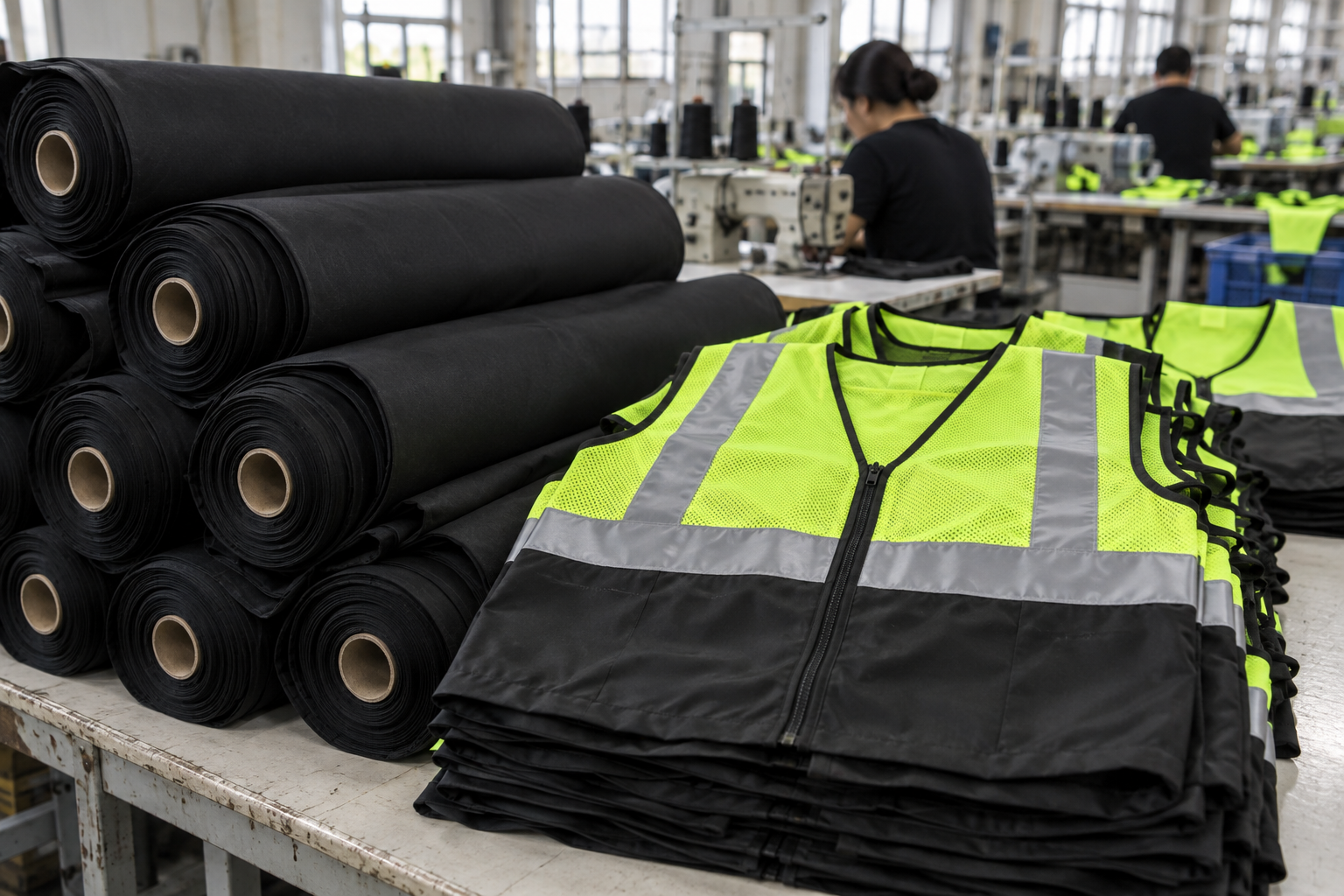
A black-bottom safety vest is a two-tone construction: the upper section keeps the fluorescent lime-green or orange-red background with retroreflective tape, while the lower section is sewn in plain black polyester or black mesh. Nothing about the black panel is decorative-only — it replaces the lower fluorescent fabric that takes the most punishment in daily wear.
The style exists across the whole range: black-bottom Class 2 vests for road-adjacent work, zipper-front versions for utilities, and multi-pocket surveyor layouts where the black bottom doubles as a softer, less visible backdrop for tool pockets.
Why distributors and crews keep reordering them
From a merchandising point of view, black-bottom vests solve the single biggest complaint about hi-vis programs: the garments look dirty long before they wear out.
- Grime stops showing. Road dust, mud and oil collect at hip level. On an all-fluorescent vest that grime is visible from across the site; on black fabric it simply disappears, so vests stay in service longer and look professional in front of clients.
- Fewer "dirty vest" replacements. Programs that reissue vests for appearance rather than wear spend less per worker per year when the bottom panel is black.
- Easier program selling. For distributors bidding on municipal or construction tenders, the two-tone look photographs better and reads as a deliberate design choice rather than basic PPE.
- Cost advantage. Black polyester in bulk is typically cheaper per meter than fluorescent fabric, so a black-bottom construction can come in below an equivalent all-fluorescent vest — ask your factory to quote both side by side.
How the black panel affects the visibility class
The visibility class lives in the fluorescent background area and the retroreflective tape, not in the black panel. Under ANSI/ISEA 107, black fabric does not count toward the background minimum, so a Class 2 black-bottom vest must still deliver the same fluorescent area as an all-fluorescent one — which is why the upper section on a compliant two-tone vest carries more fluorescent material than a casual look at the shop would suggest.
Three practical consequences for buyers:
- Engineered, not improvised. A factory that simply swaps the lower panel to black without re-checking the background area can push a vest out of class. Work with factories that measure the finished garment.
- Same rules across sizes. As with any program, the class must hold in the smallest size — see our Class 2 requirements checklist for the full pre-production check.
- Tape unchanged. Shoulder straps and bands stay on the fluorescent section; the black panel normally carries no tape, which is also why the look stays clean after washing.
What to confirm before a bulk program
| Confirm with the factory | Why it matters | Typical answer to expect |
|---|---|---|
| Black panel height | Changes the fluorescent area and the finished look | Fixed at sampling; usually around one third of body length |
| Black fabric type | Mesh breathes, solid polyester is more durable | Matched to the upper fabric or chosen for climate |
| Compliance proof | Confirms the class holds in the smallest size | Finished-garment background measurement from the factory |
| Color consistency | Black panels from different lots can shade-match poorly | Single-lot fabric allocation for the program |
| Quote vs all-fluorescent | The cost gap funds branding or a better closure | Side-by-side quotation per construction |
If your crews work hot summers, ask for the black panel in mesh — it pairs naturally with the mesh versus solid fabric trade-off and keeps the two-tone look without trapping heat.
Frequently asked questions
Need this in a bulk RFQ?
Send quantity, target styles, logo file and destination market. We will reply with MOQ, lead time, customization options and documentation by email or WhatsApp.
Request a Quote WhatsApp Us