Buyer answer: GSM (grams per square meter) is the single biggest hidden driver of a hi-vis vest's lifespan, drape and unit cost. As a rule of thumb: 120gsm knitted mesh for hot-weather programs, around 150gsm solid polyester tricot for year-round distribution stock, and 300D Oxford for surveyor and heavy-duty work. Specify GSM plus a tolerance on your RFQ, because the cheapest vest per piece is often the most expensive vest per wear-month.
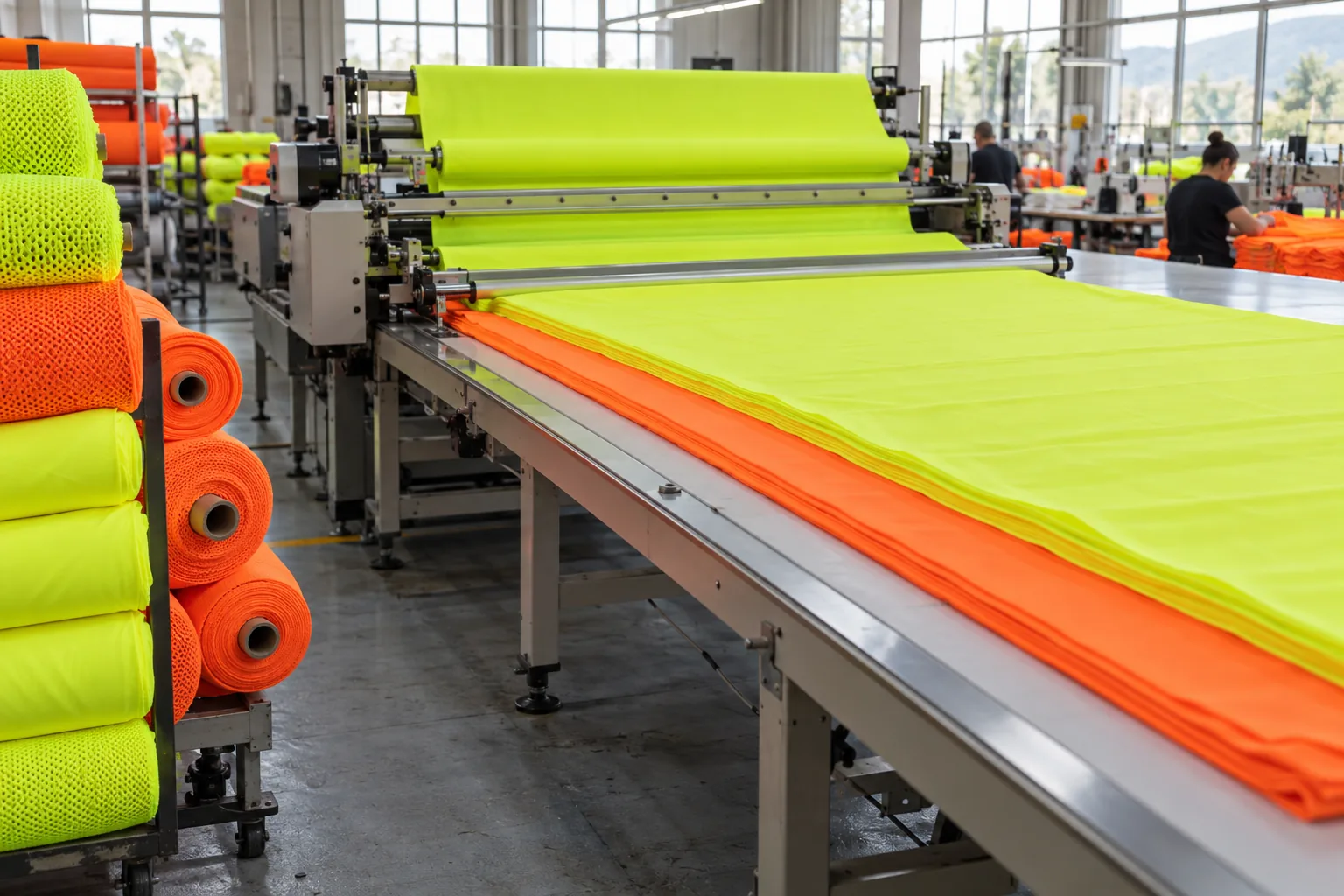
What GSM actually measures
GSM stands for grams per square meter: the weight of one square meter of fabric cut from the roll. It is the textile industry's standard way to express fabric substance, and on a hi-vis vest spec sheet it tells you more about lifespan and hand-feel than almost any other number.
Factories measure GSM with a circular sample cutter and a precision scale: a die cuts a 100 cm² disc from the fabric, the disc is weighed, and the result is multiplied to a per-square-meter figure. Across the trade, a finished-goods tolerance of roughly ±5% around the stated GSM is considered normal, because dyeing, finishing and moisture all move the number slightly. Anything wider than that gap between spec and delivery is worth questioning.
Two fabric families dominate hi-vis workwear, and they read differently on a spec sheet: knitted mesh and tricot are quoted directly in GSM (lightweight, open structure), while Oxford woven fabric is usually quoted by denier (D), a yarn-thickness measure — 300D Oxford lands in a much heavier weight class than any vest mesh.
120gsm mesh vs 150gsm tricot vs 300D Oxford
Most hi-vis vest programs land on one of three base fabrics. None is "best" — each wins on a different jobsite:
| Attribute | 120gsm Knitted Mesh | ~150gsm Solid Tricot | 300D Oxford (woven) |
|---|---|---|---|
| Airflow / heat comfort | Excellent — open knit | Moderate | Low — dense weave |
| Snag & abrasion resistance | Lower — loops catch on rough surfaces | Good | Excellent |
| Logo print surface | Needs backing or patch | Good for screen print & heat transfer | Excellent — sharpest print edges |
| Typical program | Summer roadwork, hot climates | Year-round distribution stock | Surveyor, engineering, black-bottom vests |
| Relative unit cost | Lowest | Mid | Highest |
How GSM drives total cost of ownership
Unit price and fabric weight move together: lighter mesh is cheaper to buy, heavier Oxford is more expensive. But procurement cost is only the first line of the calculation. Distributors and uniform-program managers should compare cost per wear-month, not cost per piece:
- Wash cycles: heavier, denser fabrics tolerate repeated industrial laundering far better than open mesh. A vest that survives twice as many wash cycles effectively halves its replacement frequency.
- Field damage: open mesh snags on rebar, plywood edges and tool belts. On demolition or framing sites, lightweight vests are often retired early due to tearing — not because the fluorescent color faded.
- Freight weight: on air-freighted replenishment orders, fabric weight flows straight into chargeable weight. A container of 120gsm mesh vests weighs noticeably less than the same quantity in 300D Oxford — worth modelling before you choose a fabric for an urgent order.
The pattern that emerges across export programs: mesh wins hot-weather comfort, Oxford wins lifespan, tricot wins balance. Matching the fabric to the jobsite — instead of defaulting to the lowest quote — is where distributors protect their margin and their reputation.
Writing GSM into your RFQ and verifying delivery
GSM belongs in your written specification, not in a verbal agreement. When you request a quote, state the fabric family, the target GSM and an acceptable tolerance — for example: "120gsm knitted polyester mesh, tolerance ±5%". This single line prevents the most common fabric substitution in low-cost quoting, where a 105gsm roll quietly replaces a 120gsm spec.
Three practical verification steps before and during bulk production:
- Approve a pre-production sample cut from the actual bulk roll — not from sampling yardage — and keep a signed reference swatch.
- Check opacity: hold the fluorescent fabric against light. If the background becomes see-through, the fabric is lighter than spec, which also undermines the visual bulk behind ANSI/ISEA 107 area requirements.
- Verify on delivery with AQL sampling: cut discs from random cartons and weigh them, or ask the factory for the fabric certificate accompanying the dye lot.
Confirmed on the specification sheet, GSM becomes an enforceable number — the difference between "about the same fabric" and a garment program you can audit.
Frequently asked questions
Does higher GSM always mean better quality?
No. Higher GSM means more fabric substance, which usually means longer life and higher cost — but a 300D Oxford vest in a Texas summer is worse for the wearer than a 120gsm mesh vest. Quality means fit for the jobsite, not the biggest number.
What GSM do ANSI Class 2 vests use?
ANSI/ISEA 107 regulates minimum background and retroreflective area, not fabric weight. In practice, certified Class 2 vests are made across the whole range — lightweight mesh, tricot and Oxford — so the class and the GSM are two separate lines on your spec sheet.
Can I mix fabric weights inside one order?
Yes. Many distributors split a program seasonally: mesh vests for summer replenishment, tricot or Oxford for winter. Mixing styles inside one shipment is routine; confirm how it affects the carton packing plan and unit pricing per style.
How do I check GSM when goods arrive?
Sample cartons at random, cut a fabric disc with a GSM cutter (or a precise 10 × 10 cm square) and weigh it on a 0.01g scale, then convert to per-square-meter. Compare against your spec tolerance and the factory's fabric certificate.
Need this in a bulk RFQ?
Send quantity, target styles, logo file and destination market. We will reply with MOQ, lead time, customization options and documentation by email or WhatsApp.
Request a Quote WhatsApp Us